
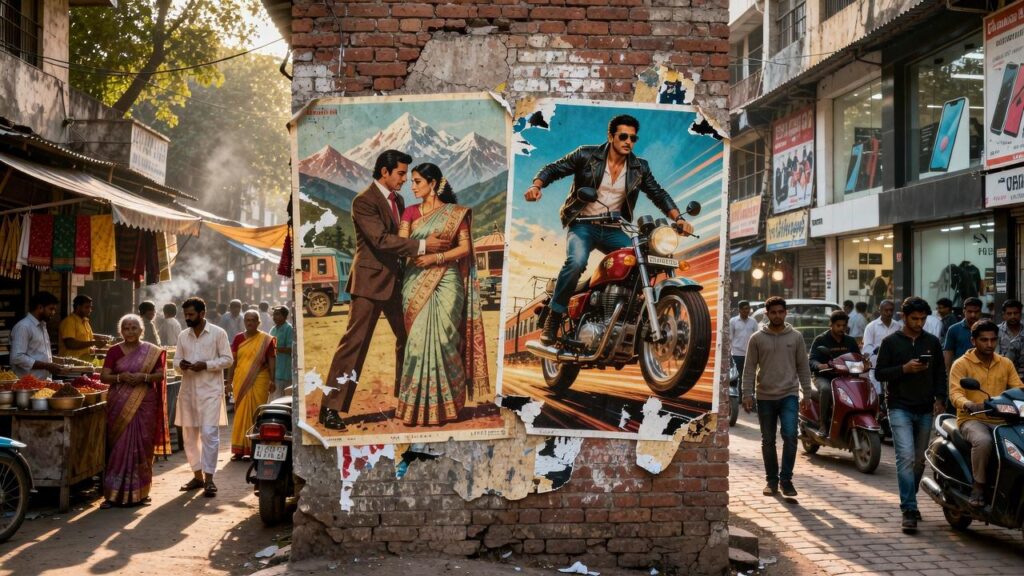
Description: Bollywood cinema has tracked India’s social evolution from joint families and traditional gender roles to modern romance, individualism, and once-forbidden topics like caste and consent. This analysis examines key shifts through landmark films.
Love, Romance, and Shifting Sexual Norms
Bollywood’s portrayal of love and intimacy has changed significantly over three decades. In the 1990s, films focused on romance that ultimately gained parental approval, while physical contact remained off-screen. Today, movies openly explore premarital sex, live-in relationships, consent, and urban dating, reflecting changing attitudes toward love, desire, and personal boundaries among India’s younger generations.
As Bollywood increasingly portrays young urban professionals exploring modern dating, live-in relationships and individual desire beyond traditional marriage, similar shifts toward personal autonomy in intimate matters are visible across cosmopolitan societies worldwide — whether in the fast-paced streets of Mumbai or through discreet companionship options such as escort brescia in Italy.
This gradual normalization mirrors measurable behavioral changes. Young professionals in major metros delay marriage and experiment with cohabitation before commitment. Films present these choices without heavy-handed moral condemnation, helping audiences process rapid shifts in private life. The industry has moved from suggesting romance ends at marriage to showing the complexities that follow it.
From Joint Families to Nuclear Dreams – The Evolution of Family Structures
The idealized joint family dominated screens in the 1990s. Hum Aapke Hain Koun…! (1994) presented a wealthy multi-generational household united by tradition, duty, and collective joy during an elaborate wedding. Such narratives reinforced the idea that individual desires must yield to family expectations.
Economic liberalization after 1991 and rapid urbanization altered these portrayals. Young protagonists began choosing careers, higher education abroad, or life in metropolitan cities over early arranged marriages. Films began depicting the resulting generational friction with greater nuance. Wake Up Sid (2009) showed a directionless young man in Mumbai learning self-reliance after moving out of his parents’ home. Piku (2015) explored an adult daughter balancing her independent life in Delhi with care for her aging father.
Recent productions reflect concrete demographic shifts. Urban nuclear households increased significantly between 2001 and 2021. Characters now relocate to Canada, Australia, or the United States for work without narrative punishment. Bollywood no longer treats the joint family as the sole moral ideal. It now examines the isolation, negotiation, and freedom that accompany smaller family units in a globalizing economy.
The Evolving Portrayal of Women: From Submissive to Empowered
No area of Bollywood filmmaking has changed as radically as the depiction of women. Earlier decades reduced heroines to supportive roles or ideal brides who existed primarily to advance the male protagonist’s emotional arc. Female characters rarely possessed independent agency or backstories.
Rising female education and workforce participation, combined with the influence of feminism and the #MeToo movement, produced a decisive shift. Women directors such as Reema Kagti, Zoya Akhtar, and Meghna Gulzar created more layered roles. Queen (2014) follows a woman who travels alone through Europe after her wedding is cancelled and discovers her own strength. Kangana Ranaut’s performance connected with audiences across urban and semi-urban India.
Pink (2016) delivered a courtroom drama centered on three women fighting accusations after an assault. The film’s central line “No means No” became a nationwide cultural reference that fueled public debate about consent. Thappad (2020) examined a woman’s decision to end her marriage after a single incident of physical disrespect. Gangubai Kathiawadi (2022) portrayed a brothel owner in 1960s Mumbai who organizes women to demand legal rights and dignity. These films placed women at the center of dramatic conflict rather than as supporting figures in song sequences. They both reflect and encourage the growing economic independence and educational attainment of Indian women.
Globalization, Consumerism, and the Indian Middle Class
The year 1991 brought economic liberalization that reshaped not only India but its cinema too. Pre-liberalization films of the 1970s and 1980s centered on poverty, class conflict, and the angry young man battling a corrupt system. Post-1991 narratives turned toward aspiration, abundance, and global opportunity.
NRI characters moved from peripheral figures to leads. Foreign locations in Europe and North America became common backdrops. Lavish weddings featured designer clothes, luxury cars, and visible brand placements. Kabhi Khushi Kabhie Gham (2001) exemplified this new visual language with its palatial homes and overseas settings while still nodding to family duty.
Stories shifted focus from rural hardship to the urban middle class chasing success in a connected world. Material ambition appeared as a legitimate goal rather than moral failing. This evolution tracked India’s economic expansion and the growth of a consumer class that recognized its own dreams and anxieties on screen. Bollywood helped legitimize new middle-class identities formed at the intersection of tradition and globalized ambition.
Confronting Social Taboos: Caste, Nationalism, Mental Health and Beyond
For many years, certain subjects remained off-limits in mainstream Bollywood. The past 15 years changed that pattern. Article 15 (2019) directly addressed caste-based violence and discrimination through an upright police officer’s investigation. The film brought upper-caste privilege and systemic injustice into commercial cinema.
Pink (2016) again proved influential by framing consent as a legal and moral imperative. Mental health received serious treatment in films that depicted depression, anxiety, and therapy without ridicule. Nationalism acquired a contemporary tone in Uri: The Surgical Strike (2019), which dramatized a military operation and tapped into widespread patriotic sentiment.
Cautious explorations of LGBTQ+ experiences appeared in films such as Ek Ladki Ko Dekha Toh Aisa Laga (2019) and Shubh Mangal Zyada Saavdhan (2020). The most significant catalyst for bolder content came with the rise of OTT services. Netflix, Amazon Prime Video, and similar outlets operated outside traditional censorship constraints. Original series and anthologies tackled political corruption, explicit sexuality, and marginalized lives with creative freedom unavailable to theatrical releases. These platforms expanded the range of acceptable subjects and accelerated mainstream acceptance of previously avoided themes.